Batch 1 · small hand-built run
Build a transistor that runs on salt water.
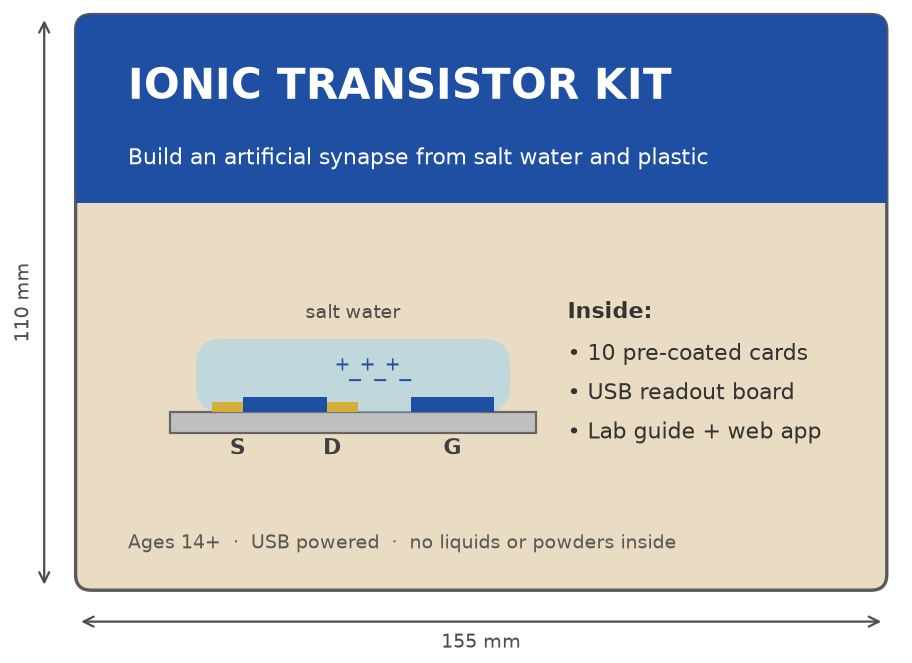
A hands-on kit for organic electrochemical transistors, the polymer devices behind bioelectronics and brain-inspired computing research. Plug in a card, add a drop of salt water, and watch the curve (and the color) change.
You're on the Batch 1 list. Check your inbox to confirm your email.
What it is
-
Switched by ions, not just electrons.
Salt-water ions move into a conductive plastic (PEDOT:PSS) and turn the current down.
-
You can see it switch.
The channel visibly darkens as the transistor turns off.
-
No liquids or powders in the box.
Cards come pre-coated. You add a pinch of kitchen salt to water.
What's in the box
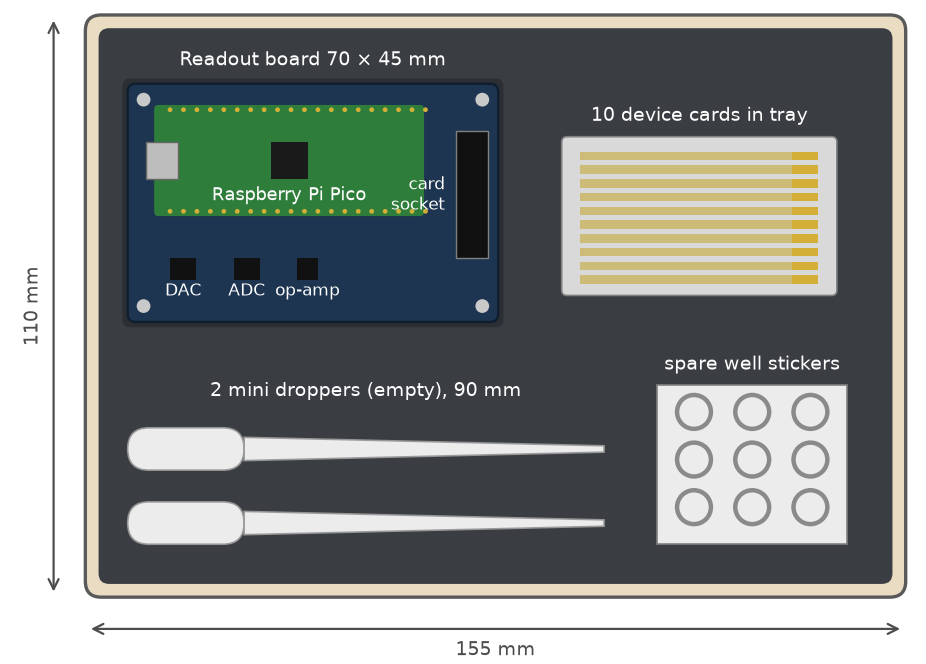
- 10 pre-coated device cards 45 × 20 mm
- USB readout board Raspberry Pi Pico–based
- Card tray
- 2 empty mini droppers
- Spare well stickers
- Quick-start card with a QR code to the full online lab guide
Box about the size of a paperback 155 × 110 × 35 mm.
How it works
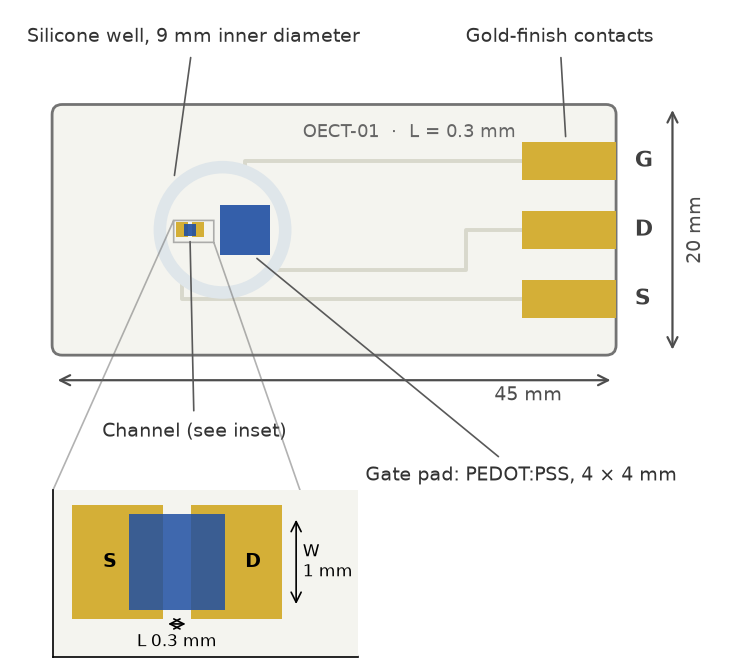
Each card has a tiny strip of PEDOT:PSS between two gold contacts (source and drain), plus a second PEDOT:PSS pad (the gate). A drop of salt water connects them.
When the board raises the gate voltage, ions are pushed into the strip, its conductivity drops, and the current falls.
That's a transistor, built from plastic, gold, and salt water.
- Channel
- W 1 mm · L 0.3 mm
- Gate pad
- 4 × 4 mm
- Well
- ⌀ 9 mm · 40–60 µL
- Contacts
- S · D · G
What you can do
Experiments planned for the online lab guide.
- 01
Transfer curve
Measure a transfer curve and see the device switch off.
- 02
Switching speed
Time how fast ions move compared with electrons.
- 03
Salt sensor
Turn a card into a salt sensor: tap water, sports drinks…
- 04
Artificial-synapse demo
Send repeated pulses and watch synapse-like memory behavior.
- 05
Inverter Advanced
Wire two cards into a simple inverter.
Up and running in 4 steps
Mix about 1 level teaspoon (~6 g) of table salt into 1 L of water.
Plug a card into the readout board and connect USB.
Put 2 drops of salt water inside the silicone ring.
Open the web app and run “Transfer curve.”
Who it's for
Makers and tinkerers
Who want something genuinely new on the bench.
Educators, outreach programs and makerspaces
Looking for a memorable hands-on demo.
Students and researchers
Who want an inexpensive way to explore OECTs.
FAQ
When does Batch 1 ship?
It's a small hand-built run and we're still finalizing the design. People on the list hear first.
How much will it cost?
Pricing isn't set yet. The interest list gets pricing first, with no obligation to buy.
Do I need lab equipment?
No. You need a computer with a USB port and Chrome or Edge, plus table salt and water.
Is there anything hazardous in the box?
No liquids or powders ship in the kit. The board runs from USB at low voltage. The kit is intended for teens (planned 14+) and adults.
Do I need to know electronics or chemistry?
No. The lab guide walks through each experiment and explains what's happening.
Will there be a version for classrooms or labs?
We're interested. Email us and tell us about your program.
Be first to hear about Batch 1
A small, hand-built run. The list hears first about timing and pricing.
You're on the Batch 1 list. Check your inbox to confirm your email.